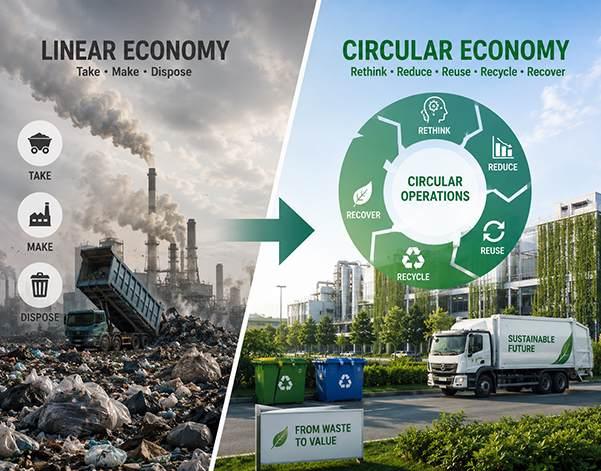
In a traditional linear model (Take $\rightarrow$ Make $\rightarrow$ Dispose), raw materials are extracted, processed
into single-use products, and sent to landfills. A circular economy model (Rethink $\rightarrow$ Reduce $\rightarrow$ Reuse $\rightarrow$
Recycle $\rightarrow$ Recover) designs out waste from the outset, keeping resources and materials circulating in productive loops to lower
operating costs and reduce carbon footprints.

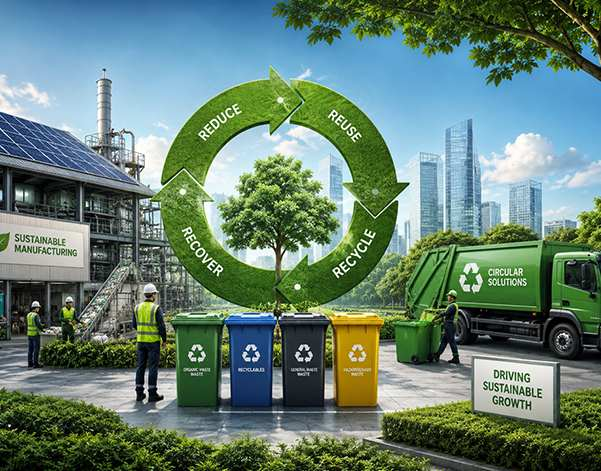
Driving Sustainable Growth Through Waste Minimization & Circular Solutions
Tailored environmental consulting to turn waste liabilities into circular assets while ensuring 100% regulatory compliance.
Why Transition to a Circular Model?Traditional linear economic models (Take $\rightarrow$ Make $\rightarrow$ Dispose) lead to resource depletion, rising operational costs, and stringent regulatory penalties.By adopting a Circular Economy framework (Rethink, Reduce, Reuse, Recycle, Recover), your organization can optimize resource efficiency, minimize environmental impact, and build a resilient supply chain.
Overview & Strategic Value
Transition from Linear to Circular Operations
Modern regulatory frameworks and ESG reporting standards require businesses to treat waste not just as a disposal challenge, but as an operational inefficiency. Jwala Risk Consulting provides end-to-end advisories that minimize environmental footprints, fulfill Extended Producer Responsibility (EPR) mandates, and transition linear supply chains into profitable, zero-waste-to-landfill operations.
Core Services Grid
Circular Economy Strategy & Capacity Building
Resource efficiency, life-cycle thinking, and operational decarbonization.
What We Do:
- Tailored circular transition roadmaps for industrial facilities.
- Corporate workshops and employee training on circular business models
- Material flow analysis to identify secondary raw material opportunities
Plastic Waste Management & EPR Compliance
End-to-end Extended Producer Responsibility (EPR) management.
What We Do:
- End-to-end registration, target fulfillment, and filing support on CPCB/SPCB portals.
- Sourcing and auditing certified PROs (Producer Responsibility Organizations) and recyclers.
- Traceability audits for post-consumer recycled (PCR) plastic integration.
Hazardous & Industrial Waste Management
Operational safety, regulatory compliance, and risk mitigation.
What We Do:
- Hazardous waste inventory assessment and risk audits (Schedule I, II & III compliance)..
- Storage, transportation, and safe co-processing/disposal standard operating procedures (SOPs)..
- Authorization support under Hazardous & Other Wastes Management Rules.
Request a Consultation
Integrated Solid Waste Management (ISWM)
Municipal, commercial, and industrial waste stream optimization.
What We Do:
- On-site segregation, composting, and waste-to-energy feasibility studies.
- Audits to achieve Zero Waste to Landfill (ZWTL) certification..
- Vendor management and audit of third-party waste handlers.
Integrated Solid Waste Management (ISWM)
Municipal, commercial, and industrial waste stream optimization.
What We Do:
- On-site segregation, composting, and waste-to-energy feasibility studies.
- Audits to achieve Zero Waste to Landfill (ZWTL) certification..
- Vendor management and audit of third-party waste handlers.
Frequently Asked Questions
-
1. What is the difference between a Linear Economy and a Circular Economy?
-
2. How does Jwala Risk Consulting help companies meet EPR Plastic Waste targets?We provide end-to-end Extended Producer Responsibility (EPR) support on the centralized CPCB/SPCB portals: establishing baseline liability, completing registration, managing EPR certificate procurement through audited recyclers/PROs, conducting material traceability audits, and filing annual returns.
-
3. What is required for Hazardous Waste Authorization under Indian environmental regulations?Under the Hazardous and Other Wastes (Management and Transboundary Movement) Rules, industrial facilities generating hazardous waste must categorize streams (Schedule I, II & III), implement secure storage SOPs, maintain Form 3 & Form 4 documentation, obtain authorization from the SPCB/TNPCB, and ensure safe handling through authorized TSDF (Treatment, Storage, and Disposal Facility) or co-processing partners.
-
4. What is Zero Waste to Landfill (ZWL) certification, and how do facilities achieve it?Zero Waste to Landfill (ZWL) verifies that a facility diverts at least 90%–99% of its solid waste away from landfills and incineration via reuse, recycling, composting, and industrial symbiosis/co-processing. We conduct comprehensive Material Flow Analyses (MFA), identify upstream reduction points, and structure auditable diversion pathways for third-party validation.
-
5. How does circular waste management improve Scope 3 emissions and ESG ratings?Solid waste sent to landfills generates methane and upstream embodied carbon. By integrating post-consumer recycled (PCR) materials, optimizing packaging, and diverting waste to secondary material loops, enterprises reduce Category 5 (Waste Generated in Operations) Scope 3 emissions and satisfy BRSR / GRI disclosure standards.